

AI-driven Research Platform
for Causal Discovery
Leonardo guides users from broad questions to precise causal claims, surfaces the most relevant evidence from top journals, and produces exportable summaries, causal maps, and research gaps.
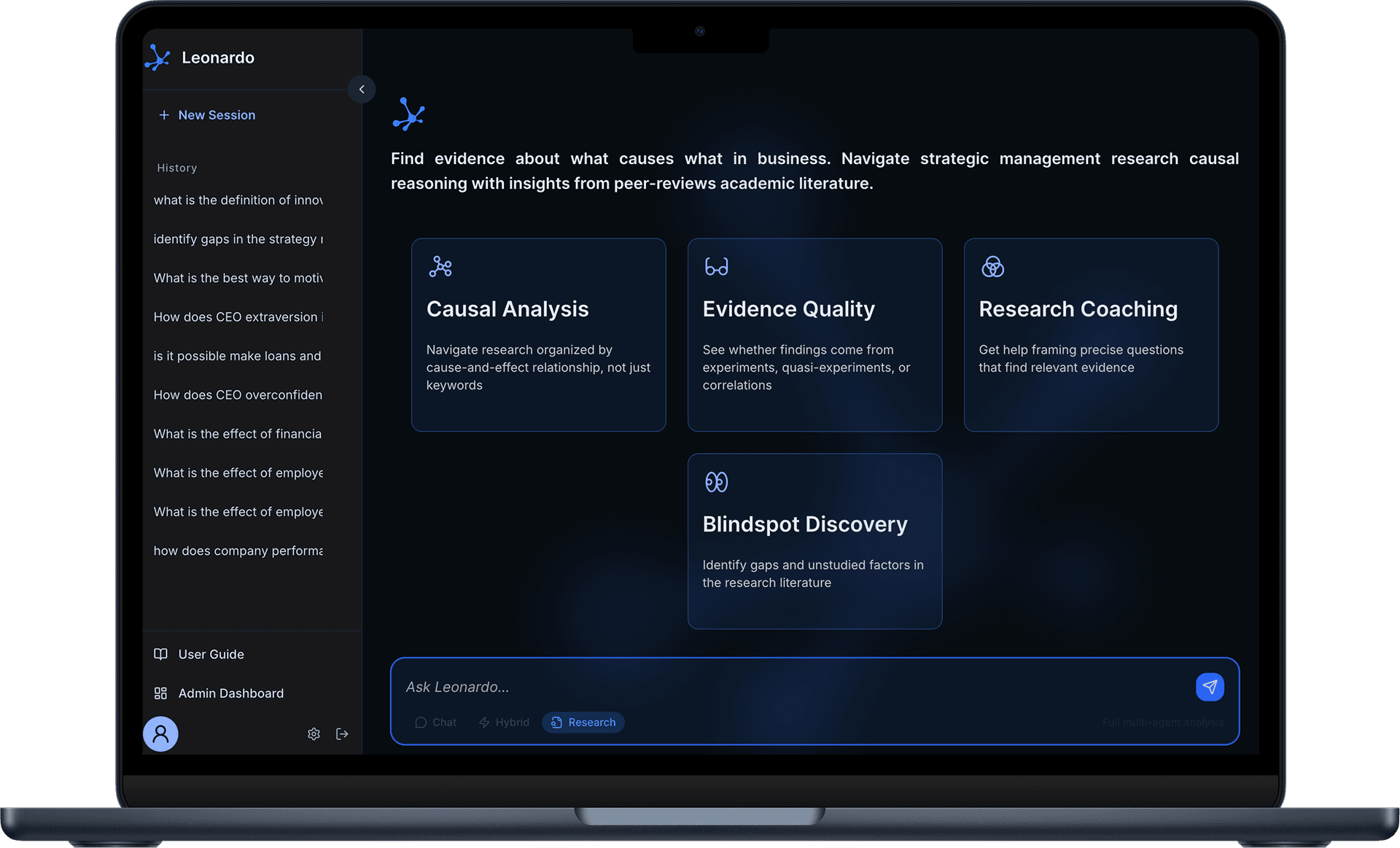
From Information Overload to Reliable Knowledge
Current research workflows and AI tools fall short of what rigorous evidence synthesis demands
The Workflow Doesn’t Scale
Traditional research tools create bottlenecks at every stage
- Google returns low-quality or irrelevant sources.
- Google Scholar has quality, but filtering and synthesis are manual.
- AI paper tools can hallucinate and blur what is actually supported.
- Manual literature reviews are time-intensive and hard to keep current.
AI Chatbots Aren’t Research-Grade
Generic AI tools lack the rigor needed for evidence-based research
- Answers shift with prompts and lack reproducibility.
- Correlation vs causation is often unclear.
- No consistent evidence-strength grading (design, alignment, consensus, recency).
- Outputs aren't delivered as structured, exportable research artifacts.
What Sets Leonardo Apart
Six key capabilities that make Leonardo fundamentally different from generic search tools and AI chatbots.
Causal-first knowledge base
Research is organised by IV→DV hypotheses, not just papers—so you retrieve evidence about effects, not just topics.
Research coaching
Leonardo helps you clarify variables (“what do you mean by performance?”), unpack causal chains, and specify mediators/moderators before searching.
Evidence strength (separate from importance)
It shows how confident we are that X causes Y—distinct from how important X might be in theory.
Interactive research artifacts
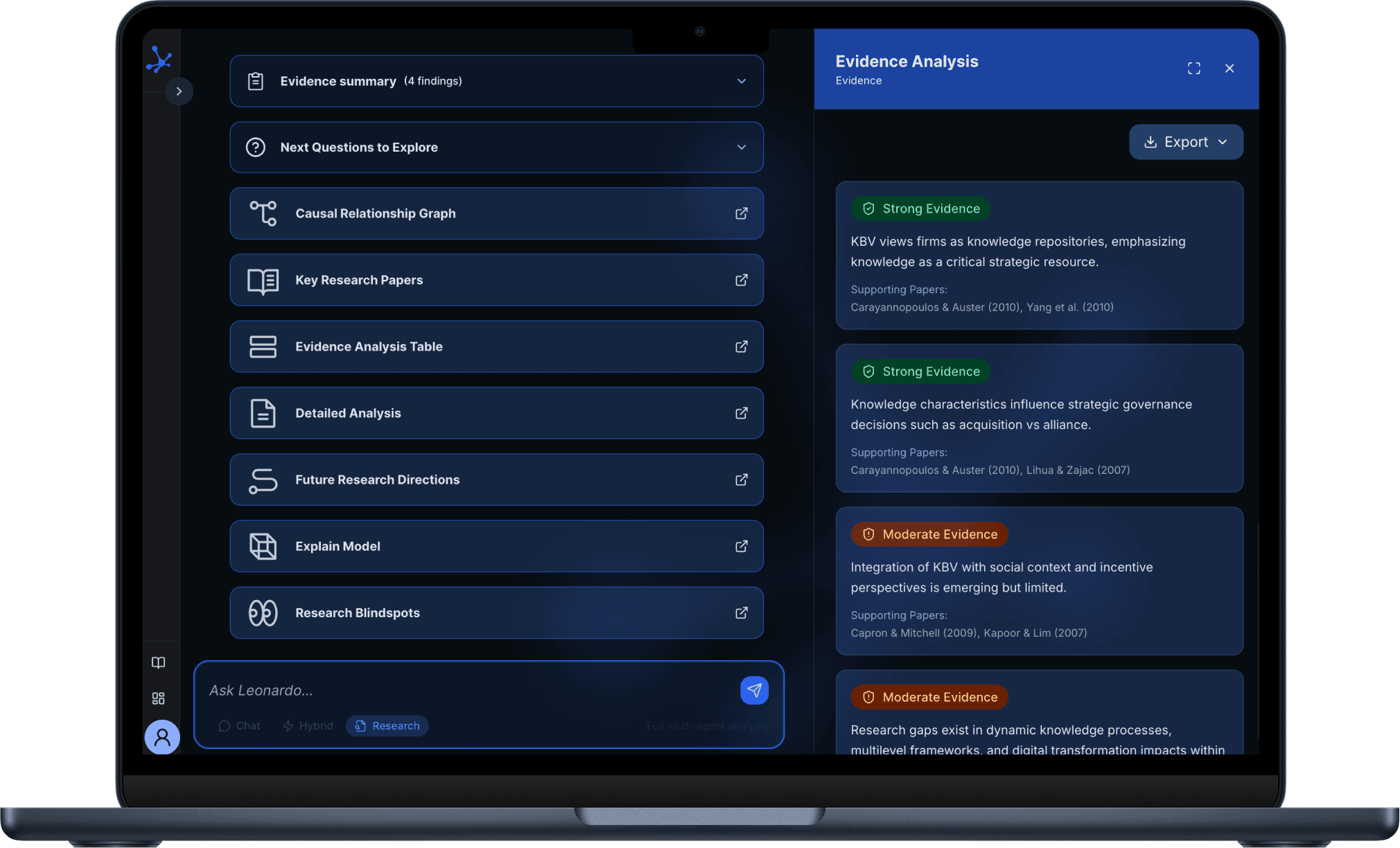
Evidence summary, DAG, key papers, evidence tables, detailed analysis, future directions, model explanation, and research gaps—built for reuse.
Reliability through constraints
Curated top journals, empirical focus, IV/DV pre-extraction, and causal-strength filtering—reliability > coverage.
Multi-agent workflow
Specialised agents orchestrate interpretation → retrieval → synthesis into consistent outputs.
System Architecture
Coordinator
Orchestrates workflow
Query Interpreter
Structures research questions
Variable Extraction
Identifies IVs, DVs, mediators
Evidence Retrieval
Academic source evaluation
Causal Analysis
Evaluates evidence strength
DAG Synthesis
Constructs causal graphs
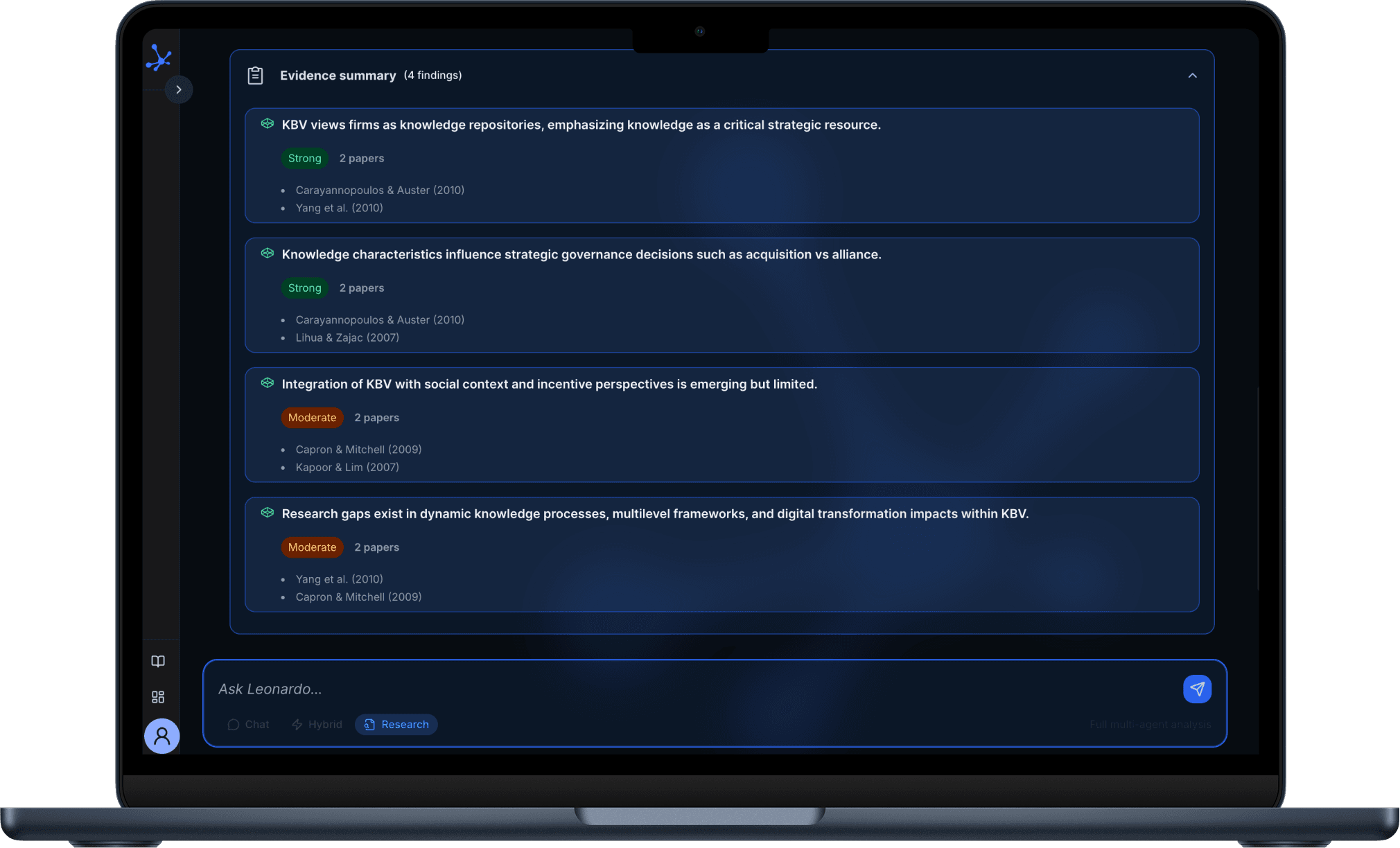
Evidence Summary
A high-level view of what the literature says about your causal question—distilled into clear X→Y relationships. Each card shows the relationship, how many studies support it, and a strength tag (e.g., Strong/Moderate) so you can quickly spot well-established versus debated findings, with citations for every claim.
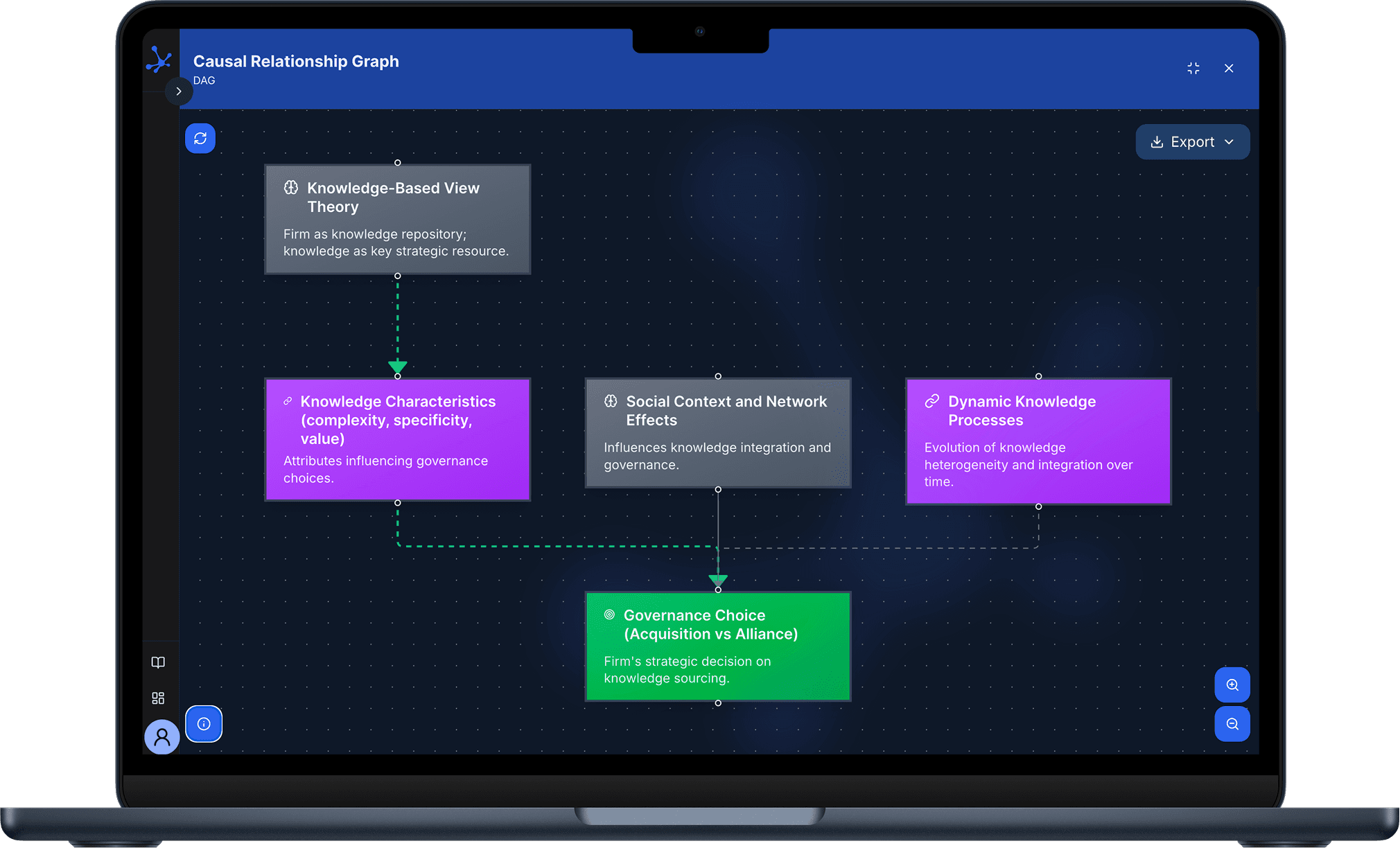
Causal DAG
An interactive directed acyclic graph that translates the retrieved literature into a structured causal model. Nodes represent variables (IV, DV, mediators, confounders), arrows show causal direction, and line styles indicate evidence strength—so you can explore mechanisms, pathways, and boundary conditions visually, and export the graph for papers and teaching.
Research Gaps
A structured gap analysis based on your causal model and the available evidence. Leonardo flags what hasn't been studied (or is weakly studied): missing variables, unexplained mechanisms, untested moderators/contexts, and temporal or measurement mismatches—then turns those into concrete next research questions and directions.
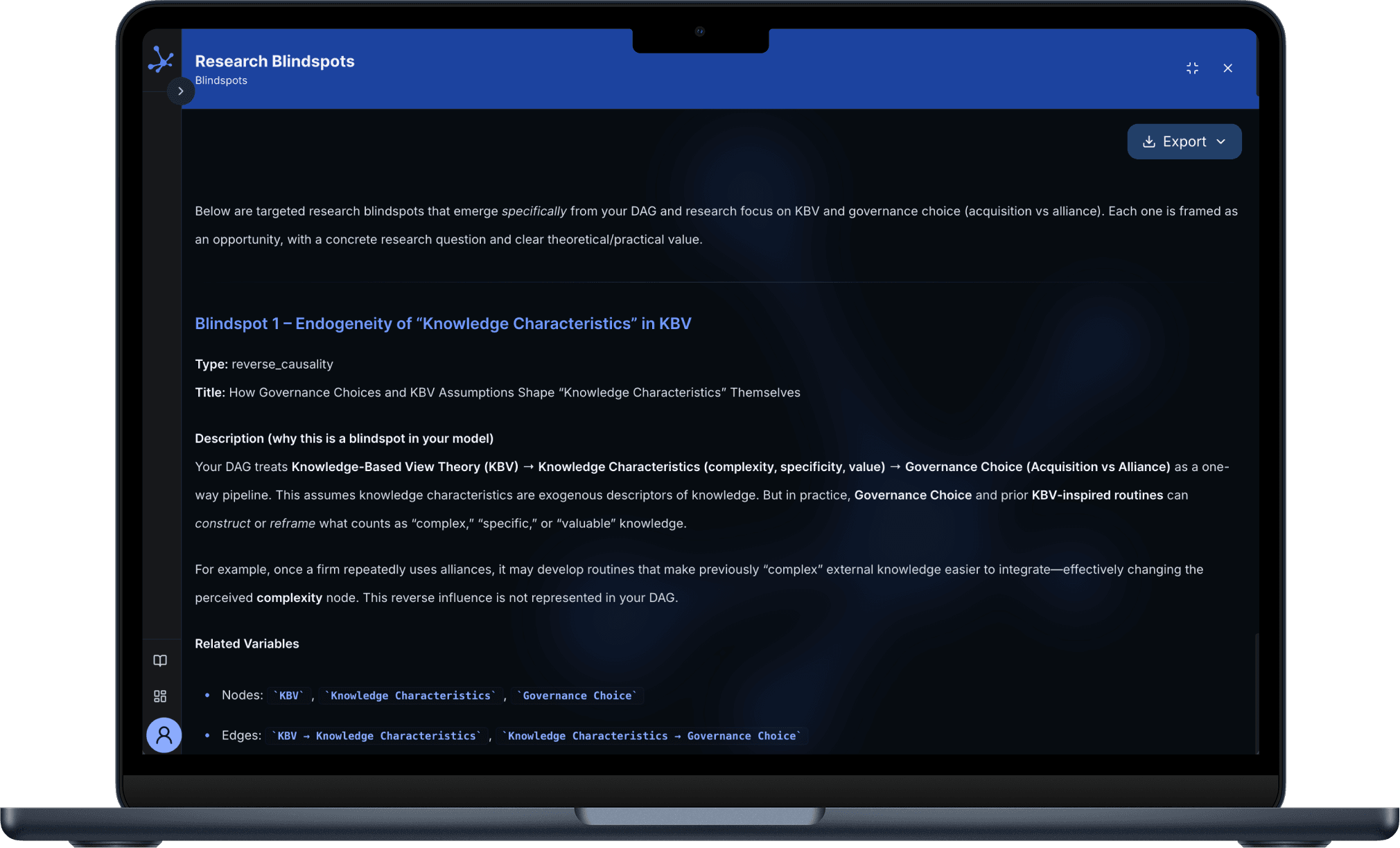
One Platform, Six Core Research Workflows
Causal Analysis
Map what causes what (X→Y) and how findings connect across studies.
Evidence Quality
See how robust the evidence is (design, alignment, consensus, recency).
Research Coaching
Turn vague topics into precise, answerable causal questions.
Gap Discovery
Identify missing variables, mechanisms, and boundary conditions.
Literature Review
Build key papers + synthesis + contradictions, with citation-ready claims.
Teaching & Learning Support
Use Leonardo as an interactive textbook; export graphs and evidence maps for lectures, cases, and assignments.
Ready to transform your research workflow?
From broad questions to precise causal claims—with evidence you can trust and artifacts you can reuse.